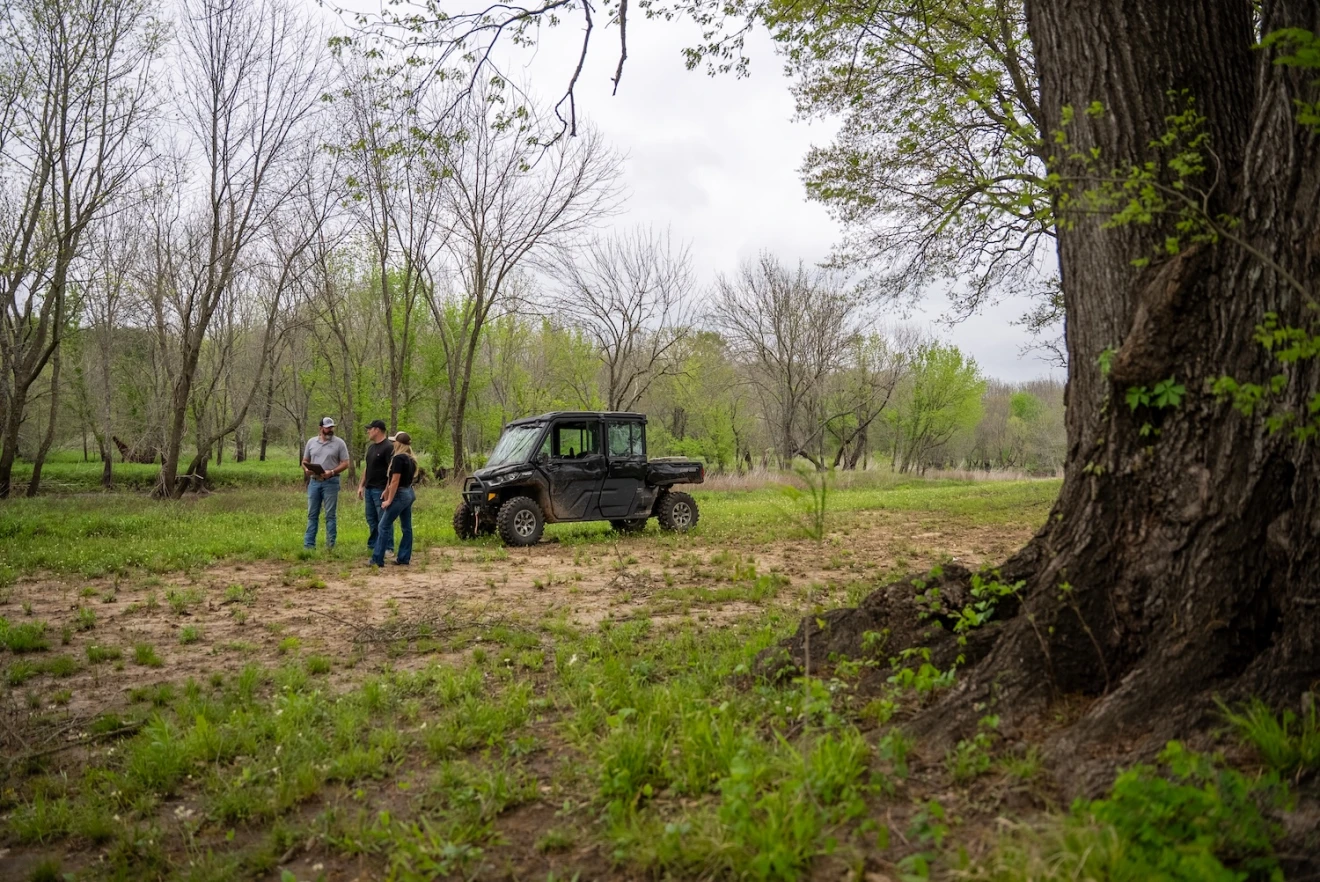
Two of the most common factors in the real estate equation include access and utilities easements. It’s vital for land buyers and sellers alike to understand easements before buying or selling land at auction. Here’s your complete guide to real estate right of ways.
Editor’s Note: This is not financial, investment, legal, or real estate advice. Consult with a financial planner, investment specialist, real estate lawyer, and real estate professional before buying or selling land at auction.
What Is an Easement?
An easement is a legally binding agreement that allows someone to cross through, or otherwise use, a specifically defined section of land owned by another person. Recorded in the deed, this explains, whether in perpetuity or for a defined portion of time, how the easement can be used.
Of course, land buyers should know about the various easement and access types. According to Dustin Pavelski, a Land Specialist with Whitetail Properties and Ranch & Farm Auctions, the various types are different. These allow for different ownership rights, legal access abilities, and more. These things even impact the land values.
What Are Access Easements?
Access easements grant a person, group of people, or entity the legal right to cross over a clearly defined area of land to reach a different property. Oftentimes, these are used in lieu of road frontage that connects land to a public roadway. Generally, this allows neighboring landowners to ingress and egress. Easements and right-of-ways cannot be gated, locked, or otherwise obstructed for parties with the legal right to access. Any locks, codes, etc. must be shared among all stakeholders. Despite the access permission, the owner of the property maintains ownership of the acreage under the deeded easement.
What Are Utilities Easements?
Utilities easements fall into two categories. While the landowner maintains ownership of the land, utilities easements permit specific actions to take place across, under, and over the easement.
First, utilities easements can grant utility service providers the right to access a property for installations, repairs, and other maintenance. This might include water lines, electric lines, gas lines, communication lines, and sewer systems.
Second, utilities easements can grant a landowner the legal ability to bring utilities services from the roadway, through the designated easement outlined, and onto their own land. This is necessary for those building homes and other structures on tracts that do not have their own road frontage.
Despite the specified allowance of access and utilities, easements generally do not allow for the installation of permanent structures (i.e.: buildings, fences, etc.) within the designated acreage. This is true for the owner of the land under the easement, and anyone granted legal use of said easement.
Deeded Easement vs. Deeded Ownership
A deeded easement is an easement written into the deed that allows for either access (ingress and egress), utilities to cross through the property, or all of the above, to reach another tract of land. “Deeded easement” does not indicate ownership, but rather, permitted usage as legally written on the deed. In contrast, from a land ownership and usage perspective, deeded ownership means you own the land.
Are Access Easements and Right of Ways the Same Thing?
The term “easement” for access and utilities is often synonymous with “right of ways.” However, it’s important to check state and local real estate law, and consult a qualified real estate attorney, to verify legal terms and descriptions.
Do Easements Remain Attached to Property Deeds After a Sale?
In most situations, permanent easements remain attached to property deeds even after a sale. It’s important to read and assess the deed to ensure details, but in most cases, easements that are “in perpetuity” virtually always remain intact and are not in danger of expiration.
Do Easements “Turn-Off” Potential Buyers?
With easements, some might ask, are easements turn-offs for potential buyers? According to Pavelski, it can be, but usually isn’t, a problem. In some instances, those buying the land for a primary residence, or who require utilities, might take greater issue with this.
“If you're looking to build a house, you might want to steer toward having the road frontage,” Pavelski said. “It can provide greater peace of mind, cleaner access, and potentially keep your building costs lower.”
Typically, a lack of road frontage can drop the price a bit. The exceptions?
1. If the deed outlines the access and utilities easements.
2. The utilities (water, electric, etc.), driveaway, and other permits are secured.
3. The utilities are already running back to the residential area(s) of interest.
4. Etc.
If those boxes are already checked, sellers can still receive quality prices for those tracts. If everything is clearly documented, it softens the blow in terms of real estate value.
He also notes that, when it comes to hunting and recreational land, it can actually be a positive to have an easement rather than road frontage.
“Say you have a 50-acre property, and it’s a long easement that’s deeded,” Pavelski said. “Now you have 50 acres that you can set up and hunt because you're not taking away 10 to 15 acres of road frontage where cars and other traffic go by.”
Fortunately, Ranch & Farm Auctions works diligently with the seller to prepare all easement matters prior to the auction. It consults the seller, determines the best plan for maximizing value and buyer interest, and executes said plan. Oftentimes, this involves a new survey to clearly mark road frontages, access and utilities easements, etc. All of the above must be clearly outlined in the deed.
Traditional Listings vs. Auctions: More or Less Negotiating Power with Easements?
Auctions typically do not allow for much negotiating. (It can, however, if the seller is willing.) In contrast, with traditional listings, there are many instances where buyers can negotiate with sellers to get the access they need or prefer.
For example, in a recent transaction, Whitetail Properties and Ranch & Farm Land Specialist David Morgan represented outdoor writer Josh Honeycutt as a buyer’s agent. The seller was only offering an easement into the property and planned to retain all road frontage. However, the buyer did not want an easement, and rather, preferred a long, slender section of road frontage. Morgan worked with the seller’s agent, and they reached an agreement to complete the sale.
“Almost everything in real estate is negotiable,” Pavelski said. “Buyers should negotiate the terms as they see fit.”
Considering the Intended Use of the Property
Always analyze the intended use for the property. Is it being bought for agriculture? Ensure it can be accessed with heavy machinery, such as combines, tractors, and implements, in a meaningful and reasonable way.
“If the access is spelled out as 20 feet wide, that’s a problem,” Pavelski said. “For a combine, or even a large tractor, that might not be suitable. So, prior to buying, negotiate that, because you are restricted down to the foot by what is outlined within the deed.”
Timber harvests, and similar endeavors, matter, too. If able to timber the property, and you're dealing with a very small easement strip, this might prevent log trucks from accessing. So, before anyone bids or otherwise buys, sit down and document all important factors. Then, sleep on it, brainstorm solutions (if needed), and make a final decision from there.
Thinking About Potential Building Projects
Think about potential building projects. Pavelski also says to ensure that an easement strip supports potential utilities for building in the future. Does the easement allow you to run electric, water, and other lines? If not, can you drill a well and successfully tap water? Is solar a viable option? Will the perc test be satisfactory for a septic system? Can a driveway permit be secured? The list goes on.
Many times, easements or right-of-ways allow for ingress and egress. However, it might have a very vague and gray area for utilities, power poles, etc. Does it allow for utilities? If it's spelled out in the deed, and agreed upon in the purchase agreement, it’s definitely more secure for your private use. This also improves potential resale value.
Contemplating Important Access Factors for Deer Hunting
There’s another element of access that only matters for hunters buying (or selling) recreational properties. From a hunting and recreational standpoint, hunters should be aware of access directions in terms of deer usage of the property. Gauge where deer likely bed, feed, and otherwise travel. Compare this to the deeded access and determine if it works for your hunt plans, or not.
“Be very cognizant of your access,” Pavelski said. “Does it work with the prevailing wind? Are you walking through bedding cover to reach hunting spots? I strongly encourage working with wildlife habitat managers or well-educated real estate agents to brainstorm these things and see if it works.”

Analyzing Deeds and Consulting Local Real Estate Authorities to Determine Legal Easement Details
Conduct title searches to analyze deeds. Pavelski encourages aspiring buyers to inspect the deed. Check for potential restrictions, especially if an easement is present. The deed will, or should, stipulate what you can and can’t do. It will list the width, length, and location of the easement.
Potential buyers must also be aware of the access type. Is it a deeded right of way? Does it not have attached road frontage, but does come with a legal access easement? Or is it completely landlocked without access?
“If you're doing an easement, or if you're buying a narrow strip, make sure you have approval from your state or your local government agency and enough for a driveway, permit, etc.” Pavelski said.
“In the state of Pennsylvania, you cannot landlock property,” Pavelski continued. “So, you have the government in your favor as a buyer. Still, there are some issues that might come up.”
Overall, work with local real estate authorities to determine legal easement details. This can be done through the local county clerk’s office. A Ranch & Farm Auctions or Whitetail Properties Land Specialist can assist with this process as well.
Do Things the Right Way. Be a Good Neighbor Before, During, and After Purchasing the Land.
In summary, always do things the right way. Be a good, kind neighbor before, during, and after purchasing land. Treat others with respect. Above all, that matters more than any real estate transaction.
“Be a good neighbor,” Pavelski said. “Being a good neighbor helps you alleviate a lot of issues. And if you can't alleviate and remove problems, move on. But we have a very good success rate of mediating, negotiating, and resolving access issues. We accomplish that by talking and working through scenarios.”
For landowners looking to sell at auction, contact Ranch & Farm Auctions. We can answer questions and help with your auctioneering needs. For buyers hoping to purchase land, check out some of the upcoming Ranch & Farm Auctions near you.